As cancer care becomes more sophisticated, our definition of cancer care must evolve too.
Cancer care is becoming more sophisticated. Earlier and more precise diagnosis. Targeted therapies. Immunotherapy. Advances in radiation and surgery. Treatments increasingly tailored to the individual and their cancer.
These advances are changing outcomes and giving many people more time.
But as cancer care becomes more medically sophisticated, our definition of what constitutes cancer care needs to become more sophisticated too.
Because cancer is never experienced solely as a disease.
It is experienced by a person.
Cancer can affect physical function, certainly, but also confidence, identity, relationships, work, independence, emotional wellbeing and connection with others. These effects can begin at diagnosis, continue throughout treatment and remain long after treatment has finished. For people living with advanced cancer, they may be part of everyday life for years.
Increasingly, international evidence and cancer strategy recognise this.
The question is no longer whether person-centred and psychosocial support matter.
The more important question is whether our cancer care systems have evolved sufficiently to deliver them.
For understandable reasons, cancer care has traditionally been viewed predominantly through a clinical lens.
Treating the disease must remain at its centre.
But international thinking about what constitutes high-quality cancer care has broadened considerably.
The Lancet Oncology Commission: The Human Crisis in Cancer has highlighted the growing imbalance between extraordinary scientific progress and the human experience of cancer care.
The World Health Organisation is calling for people-centred cancer systems that place the needs and lived experiences of people affected by cancer at their centre.
Here in Aotearoa, Te Aho o Te Kahu, the Cancer Control Agency, has made person-centred care one of four priorities in the New Zealand Cancer Action Plan 2026–2029.
And international psycho-oncology frameworks increasingly recognise psychosocial care as an essential component of high-quality cancer care, rather than an optional addition.
There is considerable alignment in where the thinking is heading.
Good cancer care treats the disease and responds to the person experiencing it.
The challenge is translating that principle into what cancer care actually looks like.
Cancer can progressively take things away.
Certainty. Control. Energy. Confidence. Strength. Routine. Independence. A sense of safety.
For some people, it changes the face they see in the mirror.
For others, it changes their relationship with their body, their ability to work, their role within their family, their social connections or their confidence participating in everyday life.
Often, several of these things happen at once.
This is not separate from the experience of cancer simply because it cannot be treated with medicine.
Research across psycho-oncology consistently points to the importance of psychological, social and practical resources in helping people cope, engage with treatment, maintain wellbeing and rebuild life.
That leads us to an important distinction.
Treating cancer and supporting someone through cancer are not the same thing. But both are necessary.
One of the great advances in modern oncology has been our increasing ability to understand the individual characteristics of a cancer and tailor treatment accordingly.
There is something important we can learn from that approach.
Precision medicine asks: what treatment does this cancer need?
Person-centred care asks: what support does this person need?
Comprehensive cancer care needs to answer both.
And the answer to the second question will not be the same for everyone.
Someone newly diagnosed may need trusted information, emotional support and practical strategies for managing uncertainty while simultaneously undergoing clinical assessment.
Someone receiving chemotherapy may need medical treatment alongside physiotherapy, psychological support, help managing changes to their appearance, strategies for anxiety and opportunities to connect with others.
Someone recovering from treatment may need rehabilitation, support returning to work, help rebuilding confidence and reassurance as they adjust to a life that may feel very different.
Someone living with advanced cancer may draw on clinical treatment, rehabilitation, practical support and community connection simultaneously for many years.
Cancer does not organise itself according to service boundaries.
Neither should the support around the person.
At Cancer Support New Zealand, this has led us to think about cancer care as an interconnected ecosystem rather than a sequence of services.
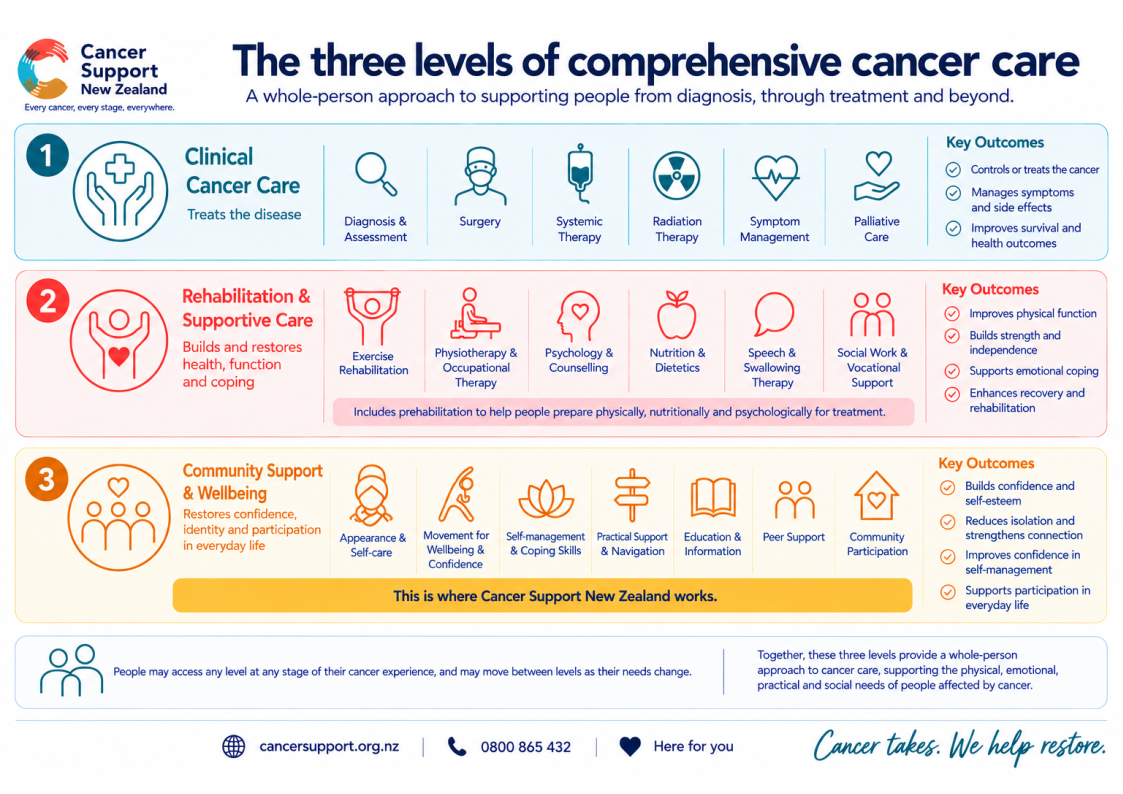
We have developed a simple framework describing Three Levels of Comprehensive Cancer Care.
The first is Clinical Cancer Care: diagnosis and assessment, surgery, systemic therapy, radiation therapy, symptom management and palliative care. Its focus is treating disease, managing symptoms and improving health outcomes.
The second is Rehabilitation and Supportive Care: services including exercise rehabilitation, physiotherapy, occupational therapy, psychology, counselling, nutrition, social work and vocational support. These help restore or maintain health, physical function, independence and coping.
The third is Living Well and Community Connection: practical and community-based support that helps restore confidence, identity and participation in everyday life through self-care, movement, self-management, information, practical support, peer connection and community participation.
But the most important part of the framework is not the distinction between the three levels.
It is the relationship between them.
They are not three steps.
A person does not complete clinical treatment, graduate to rehabilitation and eventually arrive at community support.
They may draw on any or all of these forms of support at any stage.
They are different dimensions of care surrounding the same person.
Clinical cancer care has a clearly understood role.
The importance of rehabilitation, psychological services and other forms of specialist supportive care is also increasingly recognised.
Community-based psychosocial support can be harder to locate within our traditional understanding of cancer care.
Yet this is where many of the everyday consequences of cancer are experienced.
It is where someone learns how to manage changes to their appearance caused by treatment.
Where they begin moving again and rebuild confidence in their body.
Where they develop practical strategies to cope with anxiety or uncertainty.
Where they find trusted information.
Where they meet someone else who understands.
Where they begin returning to work, relationships, activities and community life.
These interventions may appear small when compared with surgery, radiation or systemic treatment.
Their purpose is entirely different.
They help restore some of what cancer takes away.
Agency. Confidence. Understanding. Identity. Coping. Belonging. Hope. Resilience. Connection.
Cancer Support New Zealand’s framework is built around this principle: cancer can remove psychological, social and practical resources, while effective cancer support can help restore the resources people need to cope, participate in treatment and live as well as possible.
That support belongs throughout the cancer experience, not at its end.
Recognising these different dimensions of comprehensive cancer care has implications beyond language.
It changes how we think about access.
People should not need to understand the architecture of the cancer sector to find support.
Nor should they need to wait until they are struggling before discovering what is available.
Connections between clinical services, primary care, rehabilitation, NGOs and community organisations can make support easier to find at the point it is needed.
It changes how we think about timing.
Psychosocial and community support should not be regarded primarily as survivorship services.
Someone may need support with identity during treatment.
Connection at diagnosis.
Movement while receiving therapy.
Practical coping while waiting for results.
Confidence while returning to work.
Support while living long term with cancer.
The need is determined by the person, not simply by their treatment status.
And it changes how we think about outcomes.
We rightly measure survival, treatment effectiveness, waiting times, symptoms and physical function.
But if our ambition is genuinely person-centred cancer care, we should also be interested in whether someone feels more able to cope.
Whether they feel confident.
Whether they understand what is happening.
Whether they feel connected rather than alone.
Whether they can participate in everyday life.
Whether they feel more like themselves.
These aren’t substitutes for clinical outcomes.
They tell us whether another important part of cancer care is working.
There is an important point to make here.
Broadening our definition of cancer care does not mean asking oncology teams or hospitals to provide everything.
Quite the opposite.
Different parts of the cancer ecosystem bring different expertise.
Clinical teams treat disease.
Rehabilitation and specialist supportive services restore and maintain health and function.
Community organisations provide accessible practical, social and psychosocial support in the places where people live their lives.
Primary care, whānau, peer networks and communities have important roles too.
Comprehensive care does not require one organisation to do everything.
It requires us to recognise how the different parts fit together around the person.
That is where the opportunity lies.
This conversation will become increasingly important as the number of people affected by cancer grows.
We will need greater diagnostic and treatment capacity. We will need continued investment in new therapies, technologies and clinical expertise.
But increased cancer incidence also means more people managing the psychological, physical, practical and social consequences of cancer.
More people receiving treatment while trying to work and care for families.
More people living for years beyond treatment.
More people living longer with advanced cancer.
More whānau affected alongside them.
We cannot respond to increasing cancer demand with treatment capacity alone. We also need to build the support capacity surrounding treatment.
That doesn’t diminish the importance of medicine.
It reflects its success.
As cancer treatments improve and more people live longer with and beyond cancer, helping people live well becomes an increasingly important part of what successful cancer care means.
The next generation of cancer care will undoubtedly be more technologically sophisticated.
The opportunity is to make it more humanly sophisticated too.
That means recognising cancer as both a disease requiring excellent medical treatment and a profound life experience requiring different forms of support at different times.
It means moving beyond a model in which clinical care, rehabilitation and community support are viewed as separate worlds and towards one in which they are understood as interconnected dimensions of comprehensive cancer care.
And it means placing the person, rather than any particular service, at the centre.
Perhaps the test of a truly comprehensive cancer system is therefore not one question, but two:
Did we provide the best possible treatment for the cancer?
And:
Did we provide the support that person needed to live as well as possible while experiencing it?
A sophisticated cancer system should aspire to answer yes to both.
Every cancer. Every stage. Everywhere.

What you made possible Our Impact Report 2026 | Cancer Support NZ is here, and behind every number is a...
Read more

Rachael was not only the first female career firefighter in New Plymouth, she also helped design the first men’s support...
Read more
Trusted cancer support charity adopts new name to reflect expanded support One of New Zealand’s most recognised cancer support charities...
Read more
Join our community and stay up to date on our latest programmes, resources, news and events.
Cancer Support New Zealand — home of the Look Good Feel Better programme — Learn more