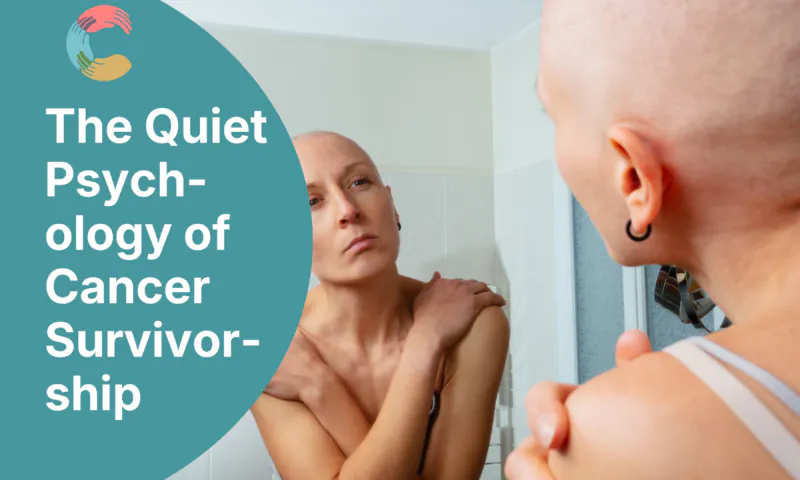
The Quiet Psychology of Cancer Survivorship
There’s a version of cancer survivorship that the world understands well.
It’s visible, public and inspirational.
It’s the ringing of bells, the triumphant social media posts, the declarations of strength and gratitude and transformation. It’s the version that fits neatly into awareness campaigns and survivorship narratives.
But there’s another version that exists quietly beneath the surface.
The version where you survive, but you’re not entirely sure how to carry what happened next.
A Cancer Support New Zealand participant describes spending much of her cancer journey trying not to become publicly known as “the person with cancer.”
“I chose to tell very few people.”
“I didn’t want people to know that I had cancer.”
For many people, that statement can sound surprising. Why hide something so significant?
But psycho-oncology research increasingly shows that cancer affects far more than physical health. It can profoundly disrupt identity, self-perception and a person’s sense of place in the world. Survivors often experience anxiety about how others may now see them professionally, socially and personally.
“I felt ashamed to be the person with cancer,” she says.
Not ashamed of being ill. Ashamed of becoming defined by it.
That distinction matters.
Before her diagnosis, she had spent 18 years working in pharmaceutical sales. She understood medicine. She understood treatment pathways. She understood the language of illness.
What she wasn’t prepared for was the emotional disorientation of suddenly becoming the patient.
“I couldn’t believe this was happening to me, and I didn’t want people to know, so I kept it very quiet for a long time.”
There is a quiet psychological split that often occurs during serious illness. Life continues externally with emails, conversations, routines and appointments, while internally, reality has fundamentally changed.
Some people respond by speaking openly about what they’re going through. Others become intensely private.
She became private.
“There are people who have no idea that I’ve been sick.”
There is exhaustion in carrying a secret that large.
Not simply because treatment is physically hard, but because concealment requires constant emotional management, deciding what to say, what not to say, how normal to appear and how vulnerable to allow yourself to be.
Researchers sometimes describe this as the burden of “invisible illness identity”, the emotional labour involved in managing a condition others cannot immediately see.
And yet survivorship itself can feel emotionally contradictory.
People expect gratitude, strength and perspective.
Sometimes survivors feel those things.
Sometimes they also feel grief, anxiety, anger, disconnection or uncertainty about who they are now.
This Cancer Support New Zealand participant describes finding stability not in grand moments, but in small rituals through Cancer Support New Zealand support programs.
A weekly Pilates class became one of the anchors of her life.
“It’s given me some structure in my life.”
“It’s just this place of Zen for me.”
The techniques she learned there became tools she returned to during episodes of anxiety late at night.
“I have used [them] in my moments of, you know, 11pm and 2am anxiety.”
Research supports the importance of these kinds of interventions. Mindfulness-based and movement-focused supportive care programs have been shown to reduce psychological distress and improve emotional wellbeing among cancer survivors.
But what she describes goes deeper than symptom management.
She is describing regulation, grounding and a way to feel psychologically safe inside her own body again.
That is often the hidden work of survivorship.
Not “moving on,” but learning how to exist alongside what happened.
There are also practical realities that remain largely invisible in public conversations about cancer.
“I’ve just spent my superannuation paying for Keytruda.”
Survivorship frequently includes financial strain, disrupted careers and altered futures alongside physical recovery. The emotional impact of this can linger long after treatment ends.
And still, despite everything, she speaks with deep appreciation for the support she received.
“I would be happy to advocate for this program, because I think it’s so important.”
But even now, she remains uncertain about becoming publicly identifiable.
“I’m just a bit concerned about being the public front.”
“Maybe it’s time I owned my journey.”
That tension may be one of the most honest parts of survivorship.
The world often asks survivors to convert pain into inspiration quickly, to become symbols of resilience before they have fully processed what survival itself has cost.
But healing is rarely linear.
Sometimes survivorship is loud.
Sometimes it is celebratory.
And sometimes it is simply a person quietly rebuilding themselves in private, one week at a time, trying to reconcile who they were before cancer with who they are now.
The quiet psychology of survivorship lives in those spaces.
Not in dramatic declarations, but in the small decisions to attend the class, to get through the night, to tell someone or not tell them, to speak publicly or remain private a little longer.
And perhaps most importantly, to understand that surviving cancer does not always mean immediately understanding what survival means.
The Growing Need for Survivorship Support in New Zealand For many people, the day cancer treatment ends is expected to...
Read more
As cancer care becomes more sophisticated, our definition of cancer care must evolve too. Cancer care is becoming more sophisticated. Earlier...
Read more
The Impacts of Cancer Care on Family, Friends and Informal Carers Cancer is often described as a personal journey. In...
Read more
Join our community and stay up to date on our latest programmes, resources, news and events.
Cancer Support New Zealand — home of the Look Good Feel Better programme — Learn more