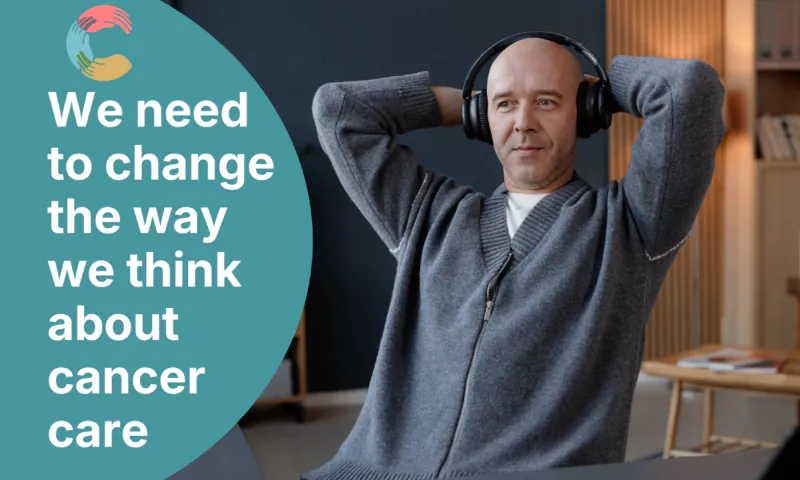
Cancer care has advanced. Now the human experience must advance with it.
Cancer care is experiencing extraordinary progress.
Advances in screening, diagnostics, surgery, radiotherapy, medicines and precision treatments mean we can detect cancer earlier, treat it more effectively and increasingly help people live longer.
But across three significant pieces of cancer thinking released in 2026, another message is becoming impossible to ignore.
Treating cancer is not the same as caring for the person who has it.
The Lancet Oncology Commission: The Human Crisis in Cancer warns that while the science of cancer has advanced enormously, the human experience of cancer care has not always kept pace.
The World Health Organisation’s Global Status Report on Cancer 2026 calls for a fundamental shift towards people-centred cancer control, placing the needs and lived experiences of people affected by cancer at the centre of how systems are designed.
And here in Aotearoa, the refreshed New Zealand Cancer Action Plan 2026–2029, from Te Aho o Te Kahu, the Cancer Control Agency, makes person-centred care one of our national priorities and states something both simple and profound:
Cancer care requires treatment of the whole person, not just the disease itself.
Together, these reports point towards an important evolution in how we think about cancer care.
Clinical outcomes matter enormously.
But so does what happens to the person while we are achieving them.
A diagnosis can suddenly reorganise someone’s life around appointments, scans, treatments and results.
But alongside those clinical experiences are changes that can be harder to see and measure.
Hair disappears. Skin changes. Brows and lashes can go. Strength and energy change. Work becomes harder. Relationships can shift. Anxiety arrives before the next scan, test or appointment.
Sometimes the person looking back from the mirror no longer feels entirely familiar.
Cancer can affect confidence, identity, independence and connection with other people. And those effects do not necessarily end when treatment does.
The Lancet Commission describes the consequences when these human dimensions of cancer are overlooked as a human crisis in cancer care.
WHO is reaching a similar conclusion.
Its 2026 global cancer report argues that cancer systems need to move towards a people-centred approach that responds not only to disease, but to the health needs and lived experiences of people and communities affected by cancer.
This matters because the global cancer burden is continuing to grow.
As more people are diagnosed and more people survive cancer, the question facing health systems is no longer simply how do we treat more cancer?
It is also:
How do we support more people to live through and beyond it?
This is not simply an international conversation.
The New Zealand Cancer Action Plan 2026–2029 identifies person-centred care as one of four priorities for cancer care in Aotearoa.
Importantly, the Plan recognises the need to support people throughout their entire cancer experience: from diagnosis through treatment, recovery and survivorship, as well as palliative and end-of-life care.
It also acknowledges a significant gap.
Access to survivorship support, psychosocial services and supportive care remains inconsistent and under-developed across New Zealand, varying by cancer type and geography.
That gap matters.
Because what happens between the hospital appointments matters too.
Cancer Support New Zealand exists within this wider cancer ecosystem.
We don’t diagnose cancer.
We don’t provide medical treatment.
And we don’t seek to replicate the specialist psychological, rehabilitation or clinical services people may need.
Our role is different.
We provide free, practical, non-medical support that sits alongside clinical care and helps people manage the visible and invisible effects of cancer in everyday life.
Across Aotearoa, our community and online programmes support people with every cancer, at every stage.
We help someone understand how to care for skin changed by treatment.
We help someone manage hair, brow or lash loss when the face in the mirror suddenly feels unfamiliar.
We create opportunities to move safely and reconnect with a body that may feel very different after treatment.
We offer practical tools for anxiety, sleep, mindfulness and emotional wellbeing.
We bring experts into people’s homes through online conversations and resources.
And sometimes we simply create a space where someone can sit alongside other people who understand.
None of those things treats cancer.
But all of them can change what it feels like to live with it.
Perhaps we need to think about cancer care as more than one system.
At one level is clinical treatment: screening, diagnosis, surgery, radiation, systemic treatments and specialist medical care.
Alongside this sits rehabilitation and supportive care: psychological services, physiotherapy, occupational therapy, dietetics, lymphoedema services, social work, palliative care and other specialist support.
And supporting both is another essential layer: community support and wellbeing.
This is where organisations such as Cancer Support New Zealand can make a distinctive contribution.
Accessible community-based services can help people put information into practice, manage the everyday effects of treatment, rebuild confidence, reconnect with others and continue accessing support when they are no longer regularly inside the hospital system.
The three layers are not alternatives.
Together, they create more complete cancer care.
The World Health Organisation is calling for governments, health systems, civil society and communities to work together to create people-centred cancer care.
Te Aho o Te Kahu describes its own role through the meaning of its name: the central thread of a cloak, bringing together the organisations, services and people that wrap around whānau affected by cancer.
That is a powerful way to think about the future of cancer support in Aotearoa.
No single organisation can provide everything a person needs.
Nor should it.
The opportunity is to create stronger connections between clinical services, specialist supportive care, primary care, NGOs and community organisations so people can move more easily between them and access the right support at the right time.
For Cancer Support New Zealand, that means being a trusted part of the support surrounding clinical care: accessible nationally, available across cancer types and stages, and able to reach people both in their communities and in their homes.
Cancer systems understandably measure what can be counted: diagnoses, waiting times, treatments, survival and mortality.
Those measures are essential.
But if we accept that person-centred care matters, our definition of success needs to extend further.
Does this person feel supported?
Can they access help with the effects of treatment?
Do they feel connected rather than isolated?
Can they participate in family, work and community life?
Are they rebuilding confidence?
Do they feel more like themselves?
And fundamentally:
Have we cared for the person as well as treating their cancer?
These are not sentimental measures.
They are measures of whether our cancer system is delivering the kind of person-centred care that the Lancet Commission, the World Health Organisation and New Zealand’s own Cancer Action Plan are now calling for.
There will, rightly, continue to be enormous investment in better diagnostics, treatments and technologies.
We need that progress.
But the international and national direction is increasingly clear.
The future of good cancer care cannot be measured by medical advancement alone.
As cancer incidence increases and more people live longer with and beyond cancer, we need to invest just as deliberately in the structures that support people outside the treatment room.
That means clinical treatment.
It means rehabilitation and specialist supportive care.
And it means accessible community support that helps people live with the impacts of cancer in the places where life actually happens.
At Cancer Support New Zealand, we see what that can look like every day.
Someone walks into a class feeling unlike themselves and leaves with a little more confidence.
Someone discovers what their body can still do.
Someone learns a practical way to manage an effect of treatment they thought they simply had to endure.
Someone who felt alone discovers a room of people who understand.
These moments may be difficult to capture in traditional measures of cancer care.
But they matter.
Because progress in cancer care should not only be measured by whether we can add years to life.
It should also be measured by how well we support people to live those years.
The science of cancer care will continue to advance.
Our challenge now is to ensure the human experience advances with it.
Every cancer. Every stage. Everywhere.
The Quiet Psychology of Cancer Survivorship There’s a version of cancer survivorship that the world understands well. It’s visible, public...
Read more
Exercise Might Be One of the Most Underused Cancer Interventions When people hear the word exercise during cancer treatment, their...
Read more

The Hidden Psychology of Working Through Cancer For many professionals, a cancer diagnosis is not only a medical event, it...
Read more
Join our community and stay up to date on our latest programmes, resources, news and events.
Cancer Support New Zealand — home of the Look Good Feel Better programme — Learn more